
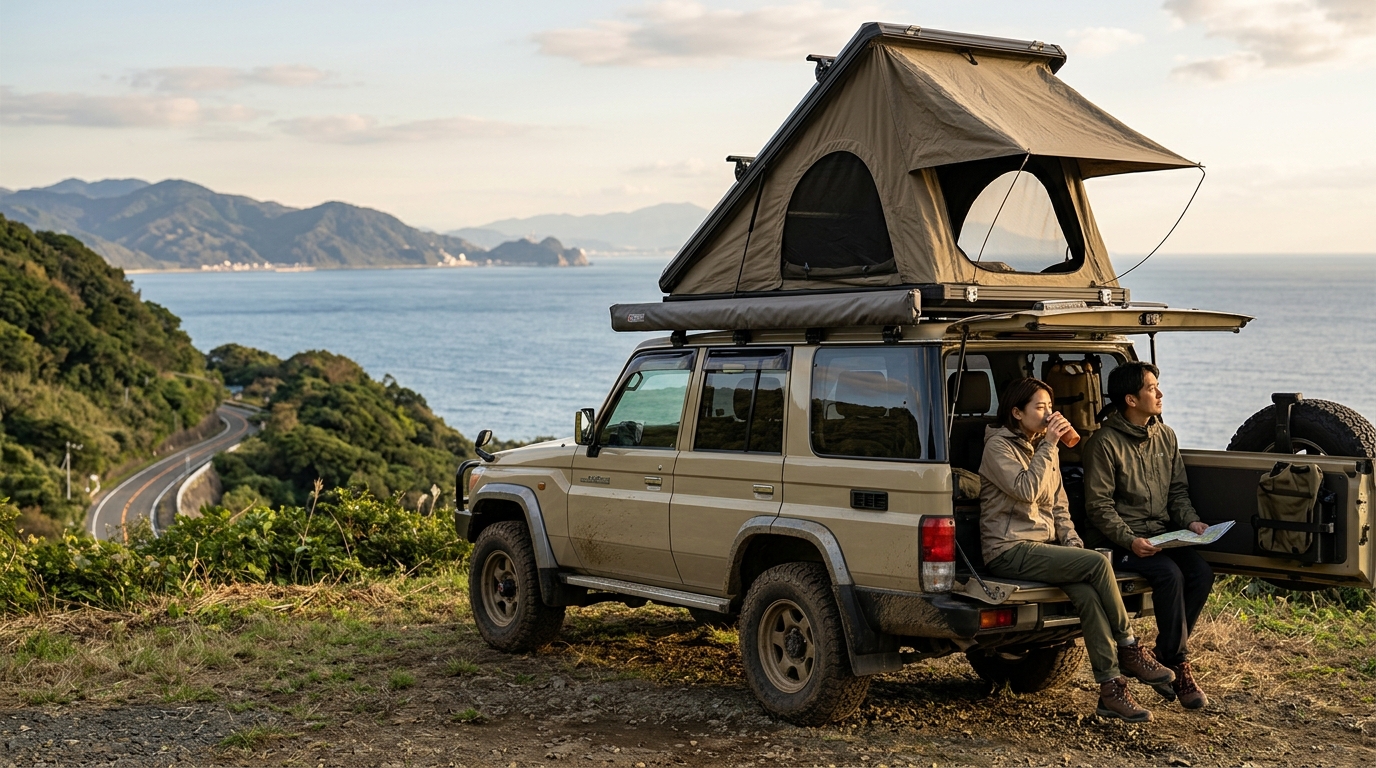
A three-to-five-day camper van trip in Japan works best when you resist the temptation to cross the entire country. Japan has excellent roads, compact towns, scenic coastlines, mountain regions, roadside stations, hot springs, and thousands of places suited to auto-camping, but distances can be deceptive. The most rewarding short trips usually focus on one region, use a realistic daily driving limit, and leave enough time to stop for food, viewpoints, bathing, walking, and spontaneous discoveries.
For international visitors, an overland camper makes this style of travel especially simple. Instead of arranging separate hotels, restaurant reservations, luggage transfers, and transport connections, you can collect a fully equipped 4x4, drive beyond the usual tourist circuit, and set up a rooftop tent wherever overnight camping is permitted. Overland Campers Japan operates from Tokyo and Fukuoka, with one-way possibilities available by prior arrangement, making regional travel more flexible. Check reservation information before fixing your route.
Japan drives on the left, and visitors should understand local road signs, speed limits, toll roads, parking rules, and mountain-road conditions before departure. The Japan National Tourism Organization also highlights the usefulness of roadside stations, known as michi-no-eki, public baths, and well-maintained roads for road-trip planning. ([japan.travel](https://www.japan.travel/en/us/blog/road-trips-and-van-life-in-japan/?utm_source=openai))
The best strategy for a 3–5 day camper van trip
The best way to use a short camper van rental in Japan is to choose a base region rather than attempt a nationwide loop. A three-day trip should generally concentrate on one principal destination and its surrounding countryside. Four days allow a larger loop, while five days can support a one-way journey or a route combining mountains, hot springs, and coastlines.
Use the one-region rule
From Tokyo, consider Mount Fuji, Hakone, the Izu Peninsula, Nikko, the northern Kanto mountains, or a carefully planned route toward Tohoku. From Fukuoka, Kyushu is naturally suited to a five-day adventure because Yufuin, Beppu, Mount Aso, Kokonoe, rural Oita, and the northern coastline can be combined without repeatedly returning to the city.
Plan fewer driving hours than you expect
Japanese expressways can make long distances manageable, but scenic mountain roads, urban traffic, narrow lanes, toll booths, weather, and sightseeing stops add time. A practical plan is to schedule one major drive per day and treat the route between destinations as part of the experience rather than trying to tick off every attraction.
Build around overnight locations
Do not assume that every attractive viewpoint or roadside station permits overnight camping. Confirm designated campsites or auto-camping facilities in advance, especially during weekends, summer holidays, autumn foliage season, and public holidays. Use campsites for sleeping, and use roadside stations primarily for rest, food, local products, and facilities unless overnight stays are clearly allowed.
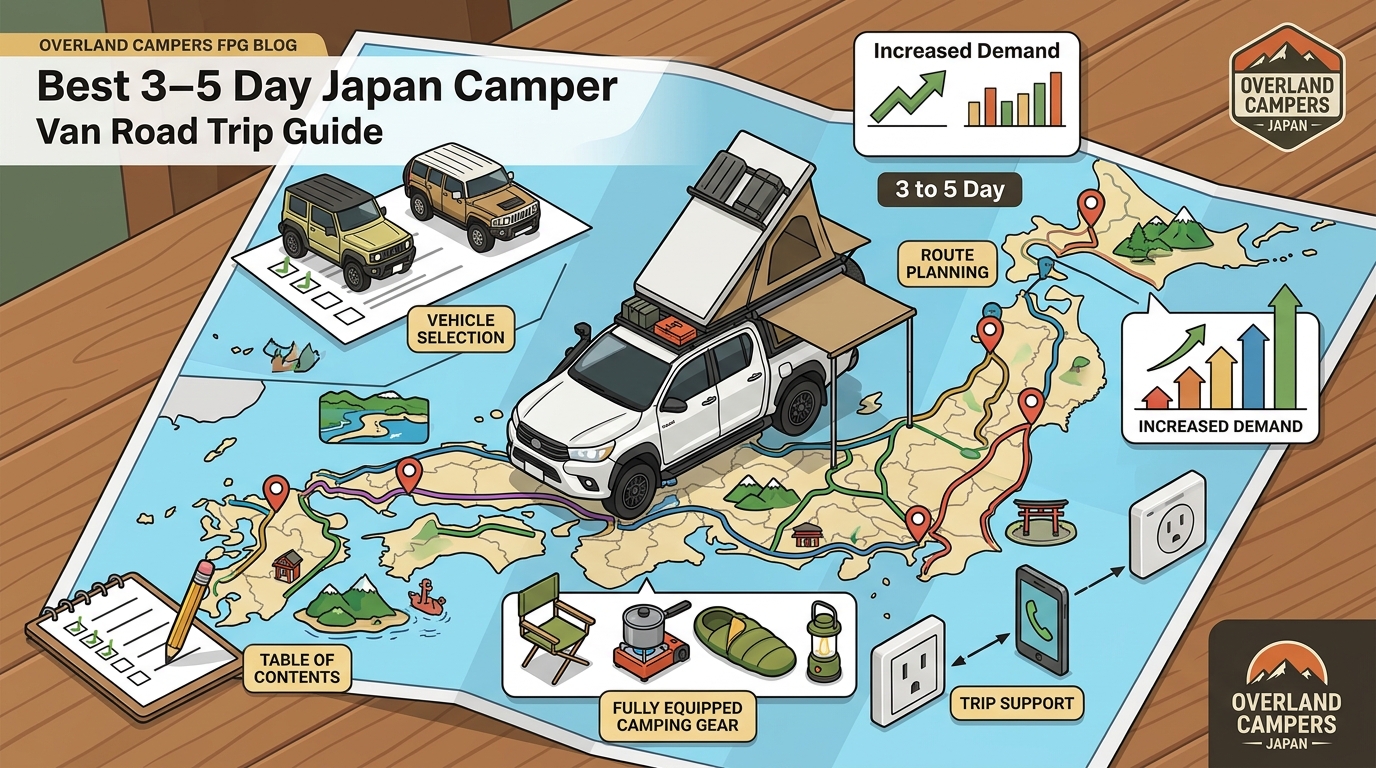
Should you start in Tokyo or Fukuoka?
| Starting point | Best for | Strong route ideas | Ideal trip length |
|---|---|---|---|
| Tokyo, Yutenji / Naka-Meguro | Travellers already visiting Tokyo who want a quick transition from city to mountains, lakes, or Mount Fuji | Mount Fuji and Hakone, Nikko, Izu, or a longer northern route | 3–5 days |
| Fukuoka, near Fukuma | Travellers seeking volcanoes, onsen towns, rural scenery, and Kyushu coastlines | Yufuin, Beppu, Mount Aso, Kokonoe, Oita, and the northern coast | 4–5 days |
The Tokyo base in Yutenji / Naka-Meguro is close to Shibuya, Shinjuku, major expressways, and Haneda access. The Fukuoka base near Fukuma provides a practical starting point for Hakata, Fukuoka Airport, Kyushu’s mountains, and the northern coastline. Current branch information and available vehicles are listed on the Overland Campers Japan homepage. ([overlandjapan.com](https://overlandjapan.com/en/?utm_source=openai))
If your international itinerary begins in Tokyo and ends in Kyushu, ask about a Tokyo-to-Fukuoka one-way rental before booking flights. One-way arrangements are subject to availability, timing, vehicle, and applicable relocation charges, so they should be agreed in advance rather than assumed. ([overlandjapan.com](https://overlandjapan.com/en/faq-travel-information/?utm_source=openai))
Choose the vehicle before you choose the route
A short trip becomes much easier when the camper matches your group and luggage. Overland Campers Japan vehicles are supplied with rooftop tents and a complete camping setup that may include bedding, shade or awning equipment, a fridge, chairs, tables, lights, cooking equipment, power, and practical cleaning supplies. Exact inclusions vary by vehicle, so read the individual vehicle description before confirming your reservation. ([overlandjapan.com](https://overlandjapan.com/en/?utm_source=openai))
Suzuki Jimny Sierra: best for two people and narrow roads
The Jimny Sierra is the nimblest option for a couple or solo traveller. Its compact footprint is useful on narrow rural roads and in small parking areas, while the rooftop tent provides a comfortable two-person sleeping arrangement. The source vehicle information lists automatic transmission, 4x4 capability, snow tyres, electronic toll readiness, and fuel economy of approximately 11 km/L. Confirm current specifications and rates when requesting a quote.
Toyota FJ Cruiser: best for extra luggage and a bigger road-trip feel
The FJ Cruiser suits travellers who want more cabin and luggage space than a compact Jimny. It is a strong choice for couples carrying substantial outdoor equipment or small groups prioritising comfort over the smallest possible footprint. Its listed fuel economy is approximately 8.4 km/L, so include a larger fuel allowance in your trip budget.
Land Rover Defender: best for comfort, style, and longer routes
Defender models are appropriate when the vehicle itself is part of the experience. Depending on the model, the setup offers five seats, a larger rooftop sleeping area, premium storage, a kitchen system, and substantial electrical capacity. Current vehicle pages list models ranging from two-plus sleepers to larger family-oriented configurations. For example, the Defender Outbound is listed with a 190 cm by 200 cm bed, seating for five, automatic transmission, diesel power, and a starting rate of ¥48,900 per day. ([overlandjapan.com](https://overlandjapan.com/en/tokyo/tokyo-defender-outbound/?utm_source=openai))
For legacy fleet details and example specifications such as the Defender 110S rooftop tent measuring approximately 130 cm by 215 cm, review the rental options page. Because vehicles and pricing can change, treat published figures as planning guidance and verify availability for your dates.
Before choosing, consider sleeping capacity, luggage volume, fuel type, road confidence, parking convenience, and whether you expect to drive mainly expressways, coastal roads, or mountain lanes. The Overland Japan FAQ can help clarify equipment, driving, and rental questions.
A flexible four-day road trip from Tokyo
This itinerary is designed as a framework rather than a rigid schedule. It works best when you select one or two main overnight areas and avoid overloading each day.
Day 1: Tokyo to the Mount Fuji or Hakone area
Collect the vehicle at the Tokyo base, complete the handover, and leave the city using the most suitable expressway route. Depending on traffic and your chosen overnight area, drive toward Lake Yamanaka, Lake Motosu, the Fuji Five Lakes, or Hakone. Stop for provisions before reaching the countryside, then set up camp at a permitted facility. A first night near Mount Fuji gives you a chance to see the mountain at dawn or from the rooftop tent after dark.
Day 2: Lakes, viewpoints, and an onsen
Keep the day local. Explore one or two Fuji viewpoints, walk beside a lake, visit a small town, and schedule time for an onsen. Avoid moving campsites every few hours; the advantage of a rooftop-tent vehicle is being able to slow down and enjoy the surroundings. In clear weather, early morning usually offers better mountain visibility than the afternoon.
Day 3: Choose Hakone, Izu, or Nikko
For a culture-and-onsen emphasis, continue through Hakone. For coastlines, seafood, and ocean views, choose the Izu Peninsula. For forests, waterfalls, shrines, and mountain scenery, head toward Nikko. Nikko National Park and the Lake Chuzenji area can form a rewarding alternative to a Fuji loop, although seasonal traffic and road conditions should be checked before setting out.
Day 4: A scenic return to Tokyo
Start early, allow time for fuel and vehicle cleaning, and return through a route that includes a michi-no-eki or local market. These roadside stops are useful for regional produce, snacks, souvenirs, toilets, and a final break before urban traffic. Plan to arrive at the agreed return location with enough time for the inspection and handover.
A five-day Kyushu mountains-and-onsen route
Kyushu is particularly well suited to a five-day camper adventure because its volcanic landscapes, hot spring towns, rural roads, and coastal scenery can be combined into a coherent loop from Fukuoka.
Day 1: Fukuoka to Yufuin
Collect your camper near Fukuma and drive toward Yufuin. Allow time for a relaxed lunch, a walk through the town, and an evening bath. Yufuin is a useful first stop because it provides a gentle transition from the city to the quieter mountain landscape. Overnight at a designated camping facility in the wider area.
Day 2: Yufuin to Mount Aso
Continue toward Mount Aso and the surrounding caldera. The route combines open farmland, mountain views, volcanic terrain, and changing weather. Visit permitted viewpoints and follow all current access restrictions around the crater, as volcanic conditions can affect roads and facilities. Camp near the Aso region where overnight camping is authorised.
Day 3: Aso to Beppu
Drive east toward Beppu, one of Japan’s best-known hot spring destinations. Spend the day exploring geothermal areas, steam-filled streets, and bathing facilities. The famous “hells” are sightseeing attractions rather than ordinary bathing pools, so combine them with a proper onsen experience. Beppu is a good night for a campsite or a planned accommodation break if you want a shower and a more comfortable reset.
Day 4: Kokonoe and rural Oita
Travel through Kokonoe and rural Oita, taking time for mountain roads, local food, bridges, waterfalls, and quiet viewpoints. The Kokonoe area is known for dramatic scenery and large cedar trees, including the Kokonoe Yuraku Tree referenced in the original route concept. Keep the schedule flexible: this is the day when a small detour often becomes the highlight of the trip.
Day 5: Return to Fukuoka
Return toward Fukuoka with a practical morning departure. Leave a buffer for fuel, traffic, shopping, and the return inspection. If your onward flight leaves from Fukuoka Airport, do not plan a final sightseeing stop that depends on arriving at the depot at the last possible minute.
Practical planning checklist
Driving documents
Drivers generally need a current full driving licence, passport, and an International Driving Permit where applicable. Some countries use a licence system that requires an accredited Japanese translation instead of an IDP. Confirm the correct document pathway for your issuing country before travelling. Japan’s official travel guidance states that visitors need a Japanese licence or an International Driving Permit to rent and drive a vehicle, while the Japan Automobile Federation provides country-specific guidance. ([japan.travel](https://www.japan.travel/en/us/blog/road-trips-and-van-life-in-japan/?utm_source=openai))
Overland Campers Japan’s terms state that named drivers must present their required driving documents at collection, and that drivers are generally 21 or older, with additional conditions potentially applying to drivers under 21 or over 70. Read the current rental terms and conditions before booking.
Rental length and booking
Do not build a three-day or five-day itinerary around an assumption that every vehicle can be rented for any duration. The current FAQ states that minimum rental periods are three, five, or seven calendar days depending on the vehicle, and that one- or two-day rentals are not offered. Confirm the minimum for your chosen camper and dates in writing. ([overlandjapan.com](https://overlandjapan.com/en/faq-travel-information/?utm_source=openai))
Costs to include
- Daily rental rate and any one-way fee.
- Fuel, especially for larger petrol or diesel vehicles.
- Expressway tolls and possible electronic toll card charges.
- Campsite or auto-camping fees.
- Food, restaurant meals, and onsen admissions.
- Parking fees in popular towns and attractions.
- Travel insurance and any applicable vehicle excess or deposit.
Published fleet examples have included approximately ¥19,800 or more per day for a Suzuki Jimny Sierra, ¥23,500 or more for a Toyota FJ Cruiser, ¥29,800 or more for a Defender 90SE, and ¥33,000 or more for a Defender 110S. Current online listings also show newer vehicle configurations and rates, so use the live booking pages rather than an old price table as your final reference. ([overlandjapan.com](https://overlandjapan.com/en/reservations/?utm_source=openai))
What to pack
Because the vehicles are equipped for camping, you usually do not need to bring a tent, stove, cookware, chairs, tables, lights, or bedding. Pack compact clothing, a waterproof layer, comfortable walking shoes, personal toiletries, a towel, charging cables, a reusable water bottle, and a small day bag. In cooler seasons, bring additional warm layers even if bedding is supplied.
Road etiquette and safety
- Drive on the left and practise identifying the centre line, edge line, and opposing traffic before leaving the depot.
- Use a passenger to manage navigation; holding or operating a smartphone while driving is prohibited.
- Expect narrow lanes, steep gradients, cyclists, pedestrians, wildlife, and sudden weather changes in rural areas.
- Do not park or sleep casually in residential streets, scenic pull-offs, or restricted areas.
- Use designated campsites and follow local instructions about fires, waste, noise, and bathing.
- Allow extra time for snow, rain, typhoons, roadworks, and seasonal closures.
Vehicle comparison guide
| Vehicle | Typical capacity | Planning profile | Indicative published information | Best suited to |
|---|---|---|---|---|
| Suzuki Jimny Sierra | Seats 2; sleeps 2 | Small, agile, easy to park | Approximately 11 km/L; rates historically from about ¥19,800/day | Solo travellers and couples |
| Toyota FJ Cruiser | Seats 5; sleeps 2+ | More interior and luggage space | Approximately 8.4 km/L; rates historically from about ¥23,500/day | Couples with luggage and small groups |
| Land Rover Defender 90SE | Seats 3; sleeps 2–3 | Distinctive, capable, compact overland platform | Rates historically from about ¥29,800/day | Adventure-focused travellers |
| Land Rover Defender 110S or larger Defender models | Seats 5; sleeps up to 3 or more depending on configuration | More comfort and space for longer routes | Published examples from about ¥33,000/day; current listings vary | Families and travellers prioritising comfort |
| Toyota Hilux | Configuration dependent | Pickup-bed versatility and overland practicality | Availability depends on the current fleet | Travellers wanting cargo flexibility |
Specifications, fuel economy, sleeping layouts, prices, and fleet availability can change as vehicles are upgraded or replaced. Select the exact vehicle page and request a current quote before making non-refundable travel arrangements.
Key takeaways
- Stay regional: A focused Tokyo or Kyushu route is usually more enjoyable than trying to cover all of Japan in five days.
- Choose the vehicle first: The Jimny favours agility and simplicity, while the FJ Cruiser and Defender models provide more space and comfort.
- Use designated campsites: A rooftop tent does not mean you can sleep anywhere; verify overnight permissions.
- Leave driving buffers: Mountain roads, traffic, tolls, weather, and scenic stops make ambitious schedules tiring.
- Confirm documents: Check whether you need an IDP or an authorised Japanese translation before arrival.
- Verify current rental rules: Minimum rental periods, prices, fleet models, deposits, and one-way availability may vary.
- Consider one-way travel: A Tokyo-to-Fukuoka plan can reduce backtracking when arranged in advance.
Frequently asked questions
What is the best region for a three-day camper van trip in Japan?
For three days, choose a compact region close to your pickup branch. From Tokyo, Mount Fuji, Hakone, Izu, or Nikko are practical choices. From Fukuoka, a shorter Yufuin and Beppu itinerary can work, although Kyushu’s best mountain-and-volcano routes are more comfortable with four or five days.
Can I travel from Tokyo to Fukuoka in five days?
Yes, but it is a long-distance journey and should be treated as a one-way expedition rather than a relaxed loop. Ask Overland Campers Japan whether a Tokyo pickup and Fukuoka return is available for your vehicle and dates. One-way rentals require prior arrangement. ([overlandjapan.com](https://overlandjapan.com/tokyo/?utm_source=openai))
What is the minimum camper rental period?
The current Overland Japan FAQ states that the minimum is three, five, or seven calendar days depending on the vehicle. One- and two-day rentals are not offered, so confirm the requirement for the exact camper you want.
Do Overland Campers Japan vehicles include cooking equipment?
Yes. The fleet is advertised as fully equipped with rooftop tents, kitchen and cooking equipment, bedding, camp furniture, lighting, refrigeration, power, and other practical supplies. Exact equipment differs by vehicle and should be checked on its individual page. ([overlandjapan.com](https://overlandjapan.com/en/?utm_source=openai))
What documents do international visitors need?
Drivers should bring their passport, valid driving licence, and the appropriate International Driving Permit or authorised Japanese translation for their country. All named drivers should be registered and present the required documents at pickup.
Is a camper van suitable for Japan’s narrow roads?
Compact 4x4 vehicles such as the Suzuki Jimny are particularly convenient on narrow rural roads and in small parking areas. Larger vehicles offer more room but require greater care on mountain lanes, in traditional villages, and at crowded attractions.
How much should I budget for fuel?
Your fuel budget depends on distance, traffic, vehicle, fuel type, and driving style. As a planning guide, a Jimny listed at approximately 11 km/L will generally use less fuel than an FJ Cruiser listed at approximately 8.4 km/L. Calculate the expected distance, divide by the vehicle’s approximate kilometres-per-litre figure, and multiply by the current pump price.
What payment methods are accepted?
Published reservation information has listed major credit cards and WISE Payments, while Japanese-language booking information has also referenced PayPay and Visa/MasterCard. Confirm the accepted method for your reservation and ensure your card can cover any required security deposit. ([overlandjapan.com](https://overlandjapan.com/en/reservations/?utm_source=openai))
Plan your route and reserve the right camper
The ideal 3–5 day Japan camper van trip is not the one with the most kilometres. It is the trip that combines a manageable route, a suitable vehicle, legal overnight stops, and enough unscheduled time to enjoy the landscape. Start by selecting Tokyo or Fukuoka, compare the available 4x4 campers, check the current rental conditions, and then shape your itinerary around one memorable region.
To begin, browse the fleet, review the current booking process, and submit your travel dates through Overland Campers Japan. You can also review the Japanese-language reservation page, the frequently asked questions, the rental terms, and available rental options before making your final plan.