
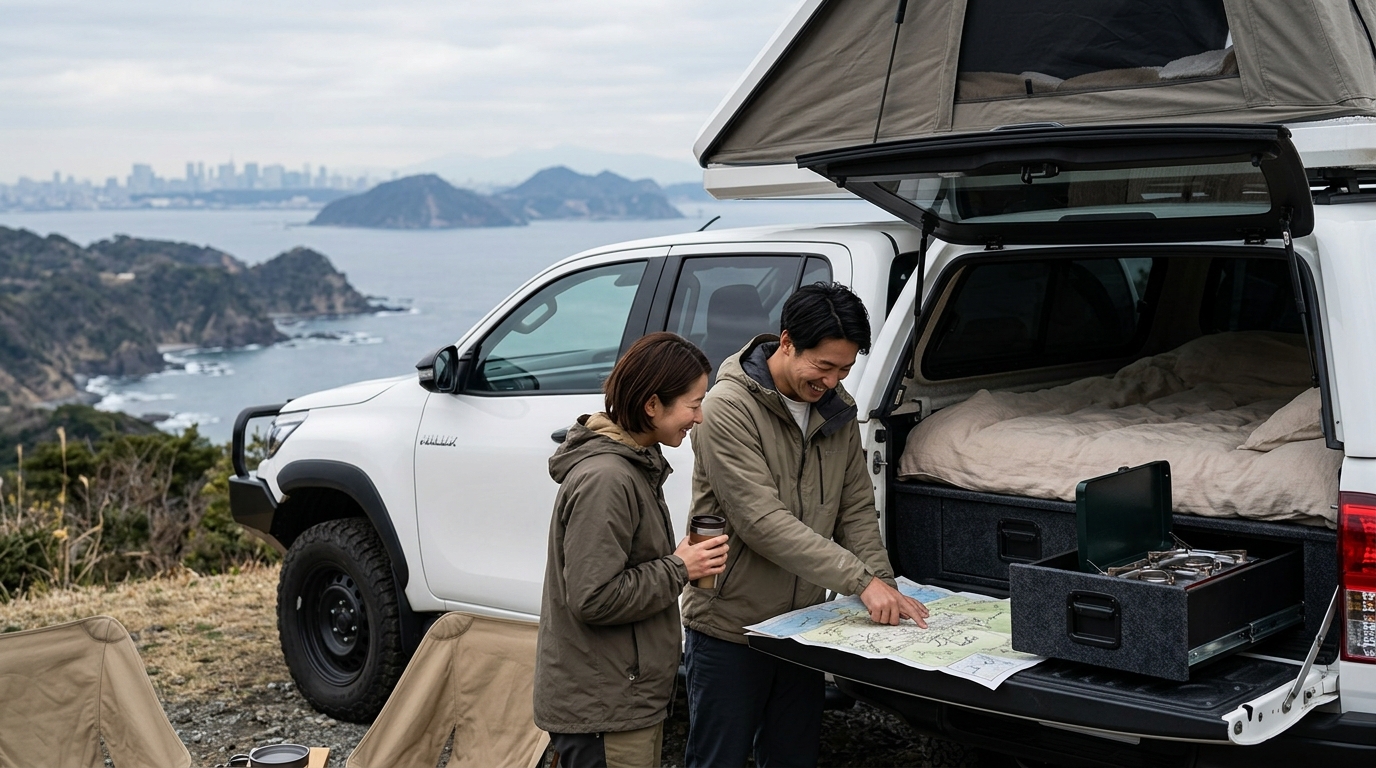
Imagine trading your Shinjuku hotel room for a rooftop tent pitched beside a volcanic lake, a Pacific coast headland, or a cedar-lined mountain pass — all within a few hours of central Tokyo. That scenario is no longer niche. Japan's domestic adventure-travel market has grown rapidly, and a new generation of custom-built 4×4 camper rentals now makes it remarkably easy to leave the city on your own schedule and sleep wherever the road takes you.
This guide breaks down everything you need to know about renting a stylish, fully equipped overlanding vehicle in Tokyo — from the specific trucks and SUVs available, to daily costs, pickup logistics, and the practical details that make or break a Japanese road-trip.
Why an Overlanding Camper Instead of a Regular Rental Car?
A standard rental car gets you from A to B, but it doesn't solve the two biggest friction points of rural Japan travel: finding accommodation in remote areas, and hauling all the outdoor gear you'd need for camping. Overlanding camper rentals bundle everything — vehicle, rooftop tent, bedding, kitchen, lighting, shelter, and power — into a single check-out so you can drive straight from the city into nature without shopping for equipment or studying campsite logistics.
Overland Campers Japan is a Tokyo-and-Fukuoka-based outfit that specialises in exactly this model. Every vehicle in their fleet ships as a turnkey adventure package: roof tent already mounted, kitchen gear stowed, and English-language support from check-in to return. The result is a “ready-to-go” experience aimed at international visitors, expat residents, couples, families, and small groups who want to explore Japan beyond the usual hotel-and-train tourist circuit.
The Vehicle Lineup: Four Distinct Personalities
Not every overlander wants the same truck. Overland Campers Japan runs a curated fleet of four 4×4 platforms, each with a different character, footprint, and price point.
Suzuki Jimny Sierra — The Agile Explorer
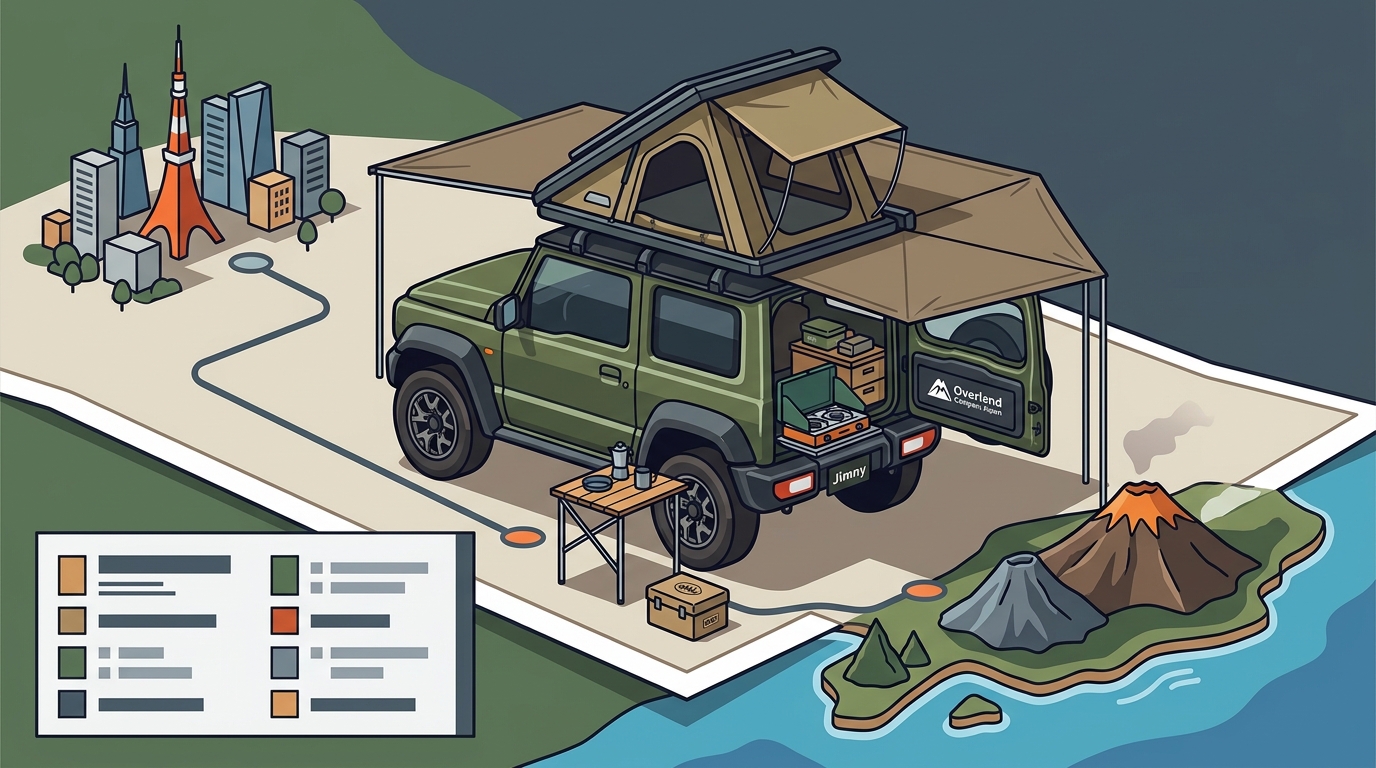
Japan's beloved kei-class off-roader (in its 1.5-litre Sierra guise) is the most compact option in the fleet. Its small turning circle and narrow body let it squeeze down single-lane forest roads and into tight mountain parking areas that bigger trucks simply cannot reach. Despite its size, the Jimny comes fully kitted with a rooftop tent for two, automatic transmission, Apple CarPlay / Android Auto, and all-season snow tyres. If you're travelling as a couple and value manoeuvrability over cabin space, this is the pick.
Toyota FJ Cruiser — The Rugged All-Rounder
The FJ Cruiser is a cult-classic off-road platform prized for its mechanical durability and retro-modern styling. With five seats and a larger cargo area, it suits groups or families who need room for extra luggage alongside the standard camping kit. Its robust suspension and approach angles make it a confident partner for longer overlanding routes that mix highway cruising with rougher tracks.
Land Rover Defender 90SE — The Short-Wheelbase Icon
The Defender 90SE pairs a shorter wheelbase with Land Rover's modern terrain-response system, giving it a classic, rugged silhouette without sacrificing on-road refinement. It sleeps up to three in the rooftop tent and seats passengers in a premium interior. Ideal for travellers who want a head-turning vehicle with genuine off-road pedigree.
Land Rover Defender 110S — The Flagship
The 110S is the largest, most spacious vehicle in the lineup. Five seats, a generous cargo bay, and a rooftop tent for three make it the top-tier choice for anyone prioritising luxury, legroom, and long-range comfort. Its diesel fuel economy (approximately 12 km/L) is surprisingly competitive for a vehicle of this size.
What Each Rental Costs — And What's Included
One of the most common surprises in the camper-rental market is the extras bill: tent hire, kitchen add-on, bedding pack, GPS unit, winter-tyre surcharge. Overland Campers Japan folds all of that into a single transparent daily rate. Here's the current pricing structure:
| Vehicle | Daily Rate (from) | Seats | Sleeps | Approx. Fuel Economy |
|---|---|---|---|---|
| Suzuki Jimny Sierra | ¥19,800 | 2 | 2 | 11 km/L |
| Toyota FJ Cruiser | ¥23,500 | 5 | 3 | 8.4 km/L |
| Land Rover Defender 90SE | ¥29,800 | — | 3 | — |
| Land Rover Defender 110S | ¥33,000 | 5 | 3 | 12 km/L |
All rates include the rooftop tent, full kitchen setup, portable power systems, bedding, and premium camping accessories. A minimum two-day rental applies across the fleet, which makes sense — you need at least one night under the stars to appreciate what these rigs can do. Payments are accepted via Visa, MasterCard, and PayPay. Full rental terms are available on the rental agreement page.
Where to Collect Your Camper in Tokyo (and Fukuoka)
Yutenji, Meguro — The Tokyo Hub
The main Tokyo check-in point sits in the Yutenji neighbourhood of Meguro ward, a quiet residential area that happens to be perfectly positioned for quick highway access. Key distances:
- Shibuya: ~6 minutes by car
- Shinjuku: ~15 minutes
- Yokohama: ~25 minutes
- Haneda Airport: ~30 minutes
- Narita Airport: ~90 minutes
The location is also a short walk from Yutenji Station (Tōkyū Tōyoko Line) and close to the popular Nakameguro and Daikanyama neighbourhoods, so you can combine vehicle pickup with some last-minute city exploration.
Fukuma, Fukuoka — The Kyushu Gateway
A second branch near Fukuma on Fukuoka's northern coastline opens up all of Kyushu — volcanic Aso, the hot-spring towns of Beppu and Kurokawa, and the lush Yakushima ferry port. Crucially, Overland Campers Japan offers one-way rentals between Tokyo and Fukuoka, so you can drive the length of Honshu and drop the vehicle at the other end instead of backtracking.
How Overland Campers Japan Compares to Other Tokyo Options
A handful of operators now serve the overlanding niche in Japan. Here is a brief orientation:
- Overland Campers Japan — Premium 4×4 fleet (Jimny, FJ Cruiser, Defender), rooftop-tent focused, Tokyo & Fukuoka branches, one-way rental option, English support, all gear included.
- Cloud 9 Camping (cloud9camping.jp) — Another rooftop-tent and camper rental service operating in Japan.
- Samurai Campers (samuraicampers.com) — Camper van rentals with a focus on van-life style travel.
- Tokyo Campervans (tokyocampervans.com) — Campervan hire from the Tokyo area.
The key differentiator for Overland Campers Japan is the combination of iconic 4×4 platforms (especially the Defender and Jimny), a no-extras pricing model, dual-city pickup/drop-off, and dedicated English-language trip support including demonstration videos and safety guidance.
Practical Tips for Your First Tokyo Overlanding Trip
- Get an international driving permit before you fly. Japan requires an IDP based on the 1949 Geneva Convention (not the 1968 Vienna Convention). Residents with a foreign licence need a Japanese translation from JAF.
- Load a highway ETC card. Electronic toll collection saves significant time and money on Japan's expressways. Ask at check-in whether your vehicle is ETC-equipped.
- Plan fuel stops outside cities. Rural petrol stations can close early; fill up before heading into mountainous areas.
- Use camping and parking apps. Apps like Camp Navi and Roadtrippers JP help locate legal overnight parking and campgrounds.
- Respect quiet hours. Japanese campsites and roadside rest areas (michi-no-eki) typically observe quiet hours from 22:00.
Key Takeaways
- Overland Campers Japan offers turnkey 4×4 camper rentals from Tokyo (Yutenji, Meguro) and Fukuoka (Fukuma), with every vehicle fully loaded with rooftop tent, kitchen, bedding, power, and camping gear.
- The fleet spans four platforms — Suzuki Jimny Sierra, Toyota FJ Cruiser, Land Rover Defender 90SE, and Defender 110S — covering solo travellers through to families and small groups.
- Daily rates range from ¥19,800 (Jimny) to ¥33,000 (Defender 110S) with no hidden equipment fees and a two-day minimum rental.
- One-way rentals between Tokyo and Fukuoka are available, enabling epic cross-country road trips without backtracking.
- All vehicles are 4×4, fitted with snow tyres, and ready for year-round travel across Japan's varied terrain.
- English-language support, safety guidance, and demonstration videos are provided to ensure international visitors can travel confidently and independently.
Frequently Asked Questions
How many days do I need to rent an overlanding camper in Tokyo?
Overland Campers Japan has a two-day minimum rental policy. This gives you at least one full night of camping and enough time to reach rewarding destinations outside the city, such as Hakone, the Izu Peninsula, or the Fuji Five Lakes.
Is a one-way rental between Tokyo and Fukuoka possible?
Yes. You can collect your vehicle at the Tokyo branch in Yutenji and return it at the Fukuoka branch near Fukuma (or the reverse). This opens up a legendary multi-day drive through Honshu and into Kyushu.
What camping equipment comes with each vehicle?
Every rental includes a rooftop tent, bedding, a portable kitchen setup (stove, cookware, utensils), a power system for charging devices, lighting, and shelter accessories. No additional gear purchases are necessary.
How do I get to the Tokyo branch from Haneda Airport?
The Yutenji / Naka-Meguro branch is roughly thirty minutes from Haneda Airport by taxi or train. It is also about six minutes from Shibuya and fifteen minutes from Shinjuku, making it easy to reach from most central Tokyo locations.
Are the vehicles suitable for winter driving?
Yes. Every vehicle in the fleet is a 4×4 and is equipped with snow tyres as standard, so you can confidently drive in colder months and access mountainous areas.
What fuel economy should I budget for?
The Suzuki Jimny Sierra averages about 11 km/L, the Toyota FJ Cruiser about 8.4 km/L, and the Land Rover Defender 110S approximately 12 km/L. Highway driving generally yields better figures than city traffic.
What payment methods are accepted?
Overland Campers Japan accepts Visa, MasterCard, and PayPay.
Start Planning Your Road Trip
Whether you want a weekend escape to the hot springs of Hakone or a two-week odyssey from Tokyo to Kagoshima, having the right vehicle transforms the trip. Browse the full fleet and check live availability on the Overland Campers Japan reservation page, or visit the FAQ section for answers to more detailed questions.